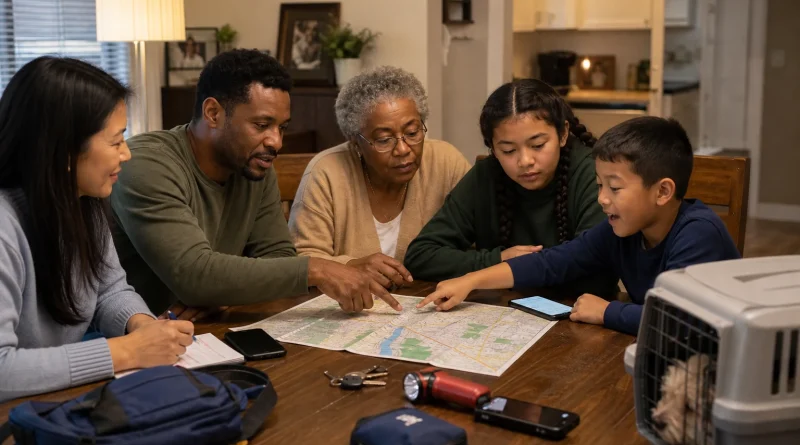
How Do You Build a Family Emergency Plan People Will Actually Remember?
A family emergency plan can be four pages long and still fail the moment the power goes out. The problem is not usually a lack of information. It is that nobody practiced the handful of decisions the document was supposed to settle.
A useful emergency plan should tell each person how to receive warnings, where to go, how to reconnect, and who needs extra help. Write those decisions down, but also make every household member explain and practice them.
Plan for separation before planning supplies
Emergencies do not wait until everyone is at home. One person may be at work, another at school, and someone else across town with the car.
Choose a nearby meeting place for a house fire or neighborhood evacuation and another location outside the neighborhood if returning home is impossible. Identify an out-of-area contact because local networks may be congested while a text or call to someone outside the affected area still goes through.
Make warnings impossible to depend on one phone
Enable local emergency alerts, learn which radio or weather service covers your area, and keep a battery-powered radio or another backup. Write essential numbers and addresses on cards for wallets, backpacks, and go-bags so a dead battery does not erase the plan.
Ready.gov offers a printable family emergency communication plan that can hold contacts, meeting places, and household details. Use it as a working tool, not a form you complete once and file away.
Assign decisions that become harder under pressure
Who will collect medications, help a family member with mobility or communication needs, secure a pet, shut off a utility if authorities advise it, or pick up a child when the usual adult cannot? A plan that says “we will help Grandma” is incomplete until someone owns the action and a backup person is named.
Include mobility devices, communication equipment, medical supplies, service animals, dietary needs, and transportation limits. If your household relies on powered medical equipment, ask the utility and healthcare provider what backup and priority-notification options exist before an outage.
Build the kit around the plan
Once you know where you may go and who is traveling, the supply list becomes more realistic. Store water, food, light, power, medications, first aid, hygiene items, clothing, cash, copies of documents, and pet supplies in forms your household can actually carry or reach.
A single heavy container in the basement is not a complete kit if flooding blocks the stairs or one person cannot lift it. Split supplies where needed and keep a smaller vehicle or evacuation bag ready.
Practice one broken assumption at a time
Run a ten-minute exercise: the usual exit is blocked, one phone is dead, and the family cannot return home. Ask each person what they would do next.
Children should know how and when to call 911, their address, where to meet, and which trusted adults may help them. Keep the exercise calm and age-appropriate; the point is familiarity, not fear.
Update the plan when the household changes
Review contacts, medications, routes, schools, jobs, pet information, and supplies at least yearly and after a move or major family change. Replace expired items and make sure new household members understand the plan.
Your emergency plan does not need to predict every disaster. It needs to remove the first few decisions that people are least equipped to make while frightened, separated, and running out of time.