What Should Be in a Software Development Project Scope Before Coding Begins?
A software project can begin with a clear-sounding request such as "build a customer portal" and still produce months of disagreement. The problem is that a feature name does not define who will use it, what they must accomplish, which systems are involved, or how anyone will decide that the work is complete.
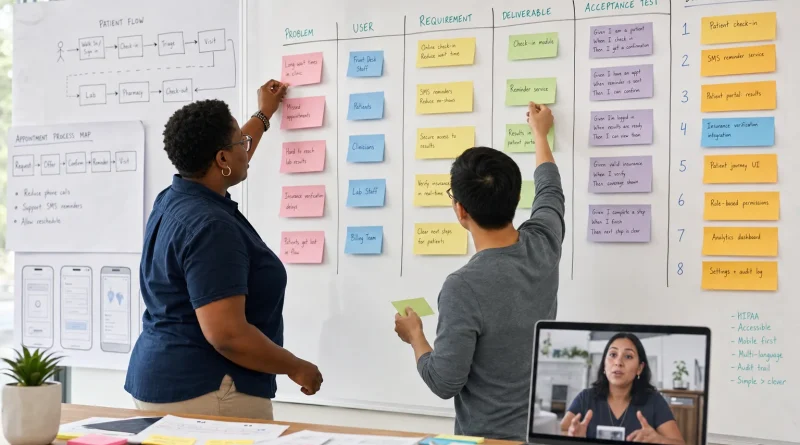
Before coding begins, your software development project scope should cover the problem, users, deliverables, acceptance tests, responsibilities, change process, ownership, security, and handoff. NIST's Secure Software Development Framework also treats security requirements, protected development environments, release integrity, and vulnerability response as work that belongs throughout development rather than after it.
Define the outcome before the feature list
Describe what must become possible and why it matters, because "customers can view invoices and pay outstanding balances without calling the office" is more useful than "payment portal" because it identifies the user and result.
List the workflows, data, roles, exceptions, notifications, integrations, and devices involved. Include what is explicitly out of scope so a missing assumption does not become an implied promise.
You should use examples for rules that can be interpreted differently. If a late fee changes after thirty days, show a sample invoice and the expected calculation.
Turn deliverables into things you can inspect
"Development" is not a complete deliverable. State whether you will receive source code, repository access, design files, database changes, documentation, test results, deployment scripts, administrator accounts, training, and a warranty period for defects.
Identify the environments included, such as development, testing, and production. Also define who supplies hosting, domains, third-party accounts, sample data, content, and access to existing systems.
Agree on acceptance before the demonstration
Acceptance criteria should describe observable results. Instead of "the portal is easy to use," specify the supported devices, required steps, permissions, performance expectations, accessibility target, and successful or failed outcomes that will be tested.
For example, a customer should be able to sign in with multifactor authentication, view only invoices belonging to their account, pay through the approved processor, receive a confirmation, and see the updated balance. That can be tested; "secure payments" by itself cannot.
Include who performs testing, how defects are recorded, what severity means, and how long the client has to accept or reject a milestone. Silence should not become acceptance unless the agreement clearly and reasonably defines it.
Control changes without pretending they will not happen
Projects reveal new information, so a useful change process records the request, reason, effect on price and schedule, alternatives, and person authorized to approve it before work begins.
Do not let informal messages silently change the contract. And do not use "out of scope" to avoid correcting work that fails the agreed acceptance criteria.
Protect ownership, security, and continuity
The agreement should state who owns custom code, what third-party or open-source components are used, which licenses apply, and whether the developer can reuse general components. Confirm repository access during the project rather than requesting the only copy after a dispute.
Define how credentials, personal data, backups, logs, and security issues will be handled. Require notification when a material vulnerability or incident affects the project.
Finally, establish deployment, rollback, documentation, training, support, and transition responsibilities. The project is not complete merely because the code works on the developer's computer.
A good scope does not predict every technical decision. It makes the important decisions visible, gives both sides a fair way to handle change, and defines success clearly enough that the final review is evidence rather than opinion.
Live Minder Connect member business
TechDex Development and Solutions
Consultants · Clayton, North Carolina and remote markets
TechDex Development and Solutions helps businesses improve visibility, security, systems, SEO, AI optimization, lead generation, and related growth strategies.