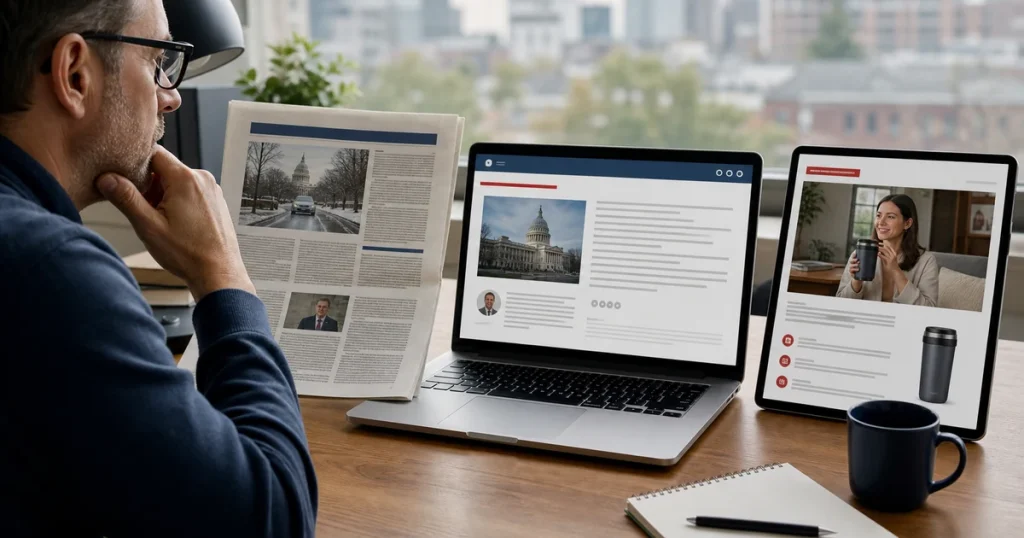
How Can You Tell Whether an Online Article Is News, Opinion, or Paid Promotion?
An online article can look polished and still be doing a completely different job from the story beside it. Before you trust or share it, identify who produced it, what kind of piece it is, who benefits from it, and whether its claims can be checked outside the page.
The useful distinction is not simply “real” versus “fake.” News reporting, analysis, opinion, and paid promotion can all contain accurate information, but they use different evidence, incentives, and standards. You need to know which one you’re reading before deciding how much weight to give it.
Start with the label, then test the whole page
Look near the headline, byline, and top of the article for labels such as News, Analysis, Opinion, Advertisement, or Sponsored Advertising Content. A clear label is useful, but it is only the beginning of the review.
The Federal Trade Commission says advertising should be identifiable as advertising and that a disclosure needed to prevent deception should be clear and prominent. Its native advertising guidance also explains why a disclosure close to the headline matters when promotional content resembles ordinary editorial material.
Do not assume that a vague word such as “Partner” tells you enough. Ask whether the label makes the commercial relationship understandable before you start reading, not after you have already absorbed the sales message.
Find out who is speaking
A reported news story normally identifies a journalist and publication. An opinion piece should identify the person or editorial board expressing the view. Paid content should make the sponsor or advertiser visible.
Click the byline when possible. Does the author have a real profile and relevant reporting history? Does the page explain its corrections policy, ownership, contact information, and editorial standards? A familiar-looking layout cannot answer those questions for you.
Notice what the article asks you to believe
Reporting should show where important facts came from. Analysis may combine verified facts with interpretation. Opinion argues for a conclusion. Paid promotion is designed to improve your view of a product, organization, or cause, even when it teaches something useful along the way.
Read the strongest sentence and ask what supports it. Is there a named document, data source, direct quotation, public record, or person with firsthand knowledge? Or does the page merely link to another article that repeats the same claim?
Follow the claim outside the article
Open the original source when the claim matters. Check whether the headline matches the document, study, court filing, public statement, or dataset it cites. Then look for independent coverage that did not originate with the same company, campaign, press release, or affiliate network.
This is where a polished promotional article often becomes easier to recognize. It may cite real numbers while omitting the comparison, limitation, or competing explanation that would help you judge them.
Use a three-question pause before sharing
- What is this? Identify the content type and any commercial relationship.
- What is the evidence? Trace the central claim to an original, inspectable source.
- What would change the conclusion? Look for missing context, contrary evidence, and meaningful uncertainty.
If you cannot answer all three, you do not have to decide that the article is false. You can simply stop treating it as settled enough to share, buy from, or use as the basis for an important decision.
When you are the source, keep the boundary clear
If you’re reading coverage of a business – especially your own – keep the same boundary in view from the other side. A paid placement is advertising, while earned coverage is an editorial decision. Our guide to getting a small business covered by local media explains how a business can provide a real story and supporting evidence without trying to take over the newsroom’s role.
The goal is not to distrust everything that has an argument or a sponsor. It is to understand the job the page is doing, then judge its evidence with your eyes open.