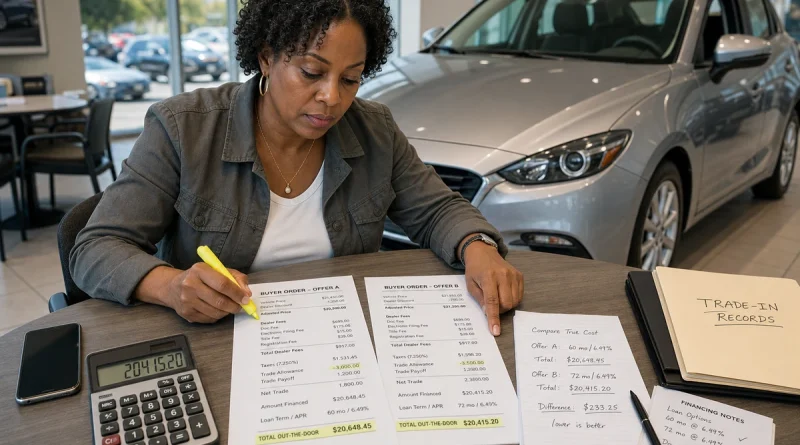
How to Compare Car Dealer Prices Using the Out-the-Door Cost
The advertised price of a car is not always the amount you must pay to take it home. Discounts may have qualifications, fees may appear later, and optional products can be introduced after you have spent hours discussing financing and a trade-in.
You should compare written out-the-door prices before comparing monthly payments. That keeps the vehicle price, financing, trade value, and optional products from being blended into one number that is difficult to evaluate.
Ask for the out-the-door price in writing
Identify the exact vehicle by VIN or stock number and request a written total that includes the selling price, dealer fees, installed products, taxes, registration, and every other charge required to complete the purchase. Ask the dealer to label any amount that depends on financing, trade-in, military status, loyalty, recent graduation, or another qualification.
The Federal Trade Commission car-advertising guidance recommends confirming that the vehicle is actually available and obtaining the out-the-door price before leaving home. A written total lets you compare offers and recognize added charges.
Keep financing separate until the price is clear
A lower monthly payment can come from a longer loan, larger down payment, higher final cost, or lease structure. Ask for the annual percentage rate, amount financed, finance charge, loan term, payment count, and total of payments.
You should compare preapproval from a bank or credit union with the dealer's financing. Dealer financing may still be the better offer, but you need another real option before you can evaluate it.
Negotiate the trade-in as a separate transaction
First establish the price of the car you are buying. Then compare written trade offers from more than one source and ask how an existing loan payoff affects the numbers.
A high trade allowance can be offset by a higher vehicle price, removed discount, or unfavorable financing. The useful figure is your complete changeover cost and loan obligation, not whether one line on the worksheet looks generous.
Review optional products one at a time
Ask for the price and written terms of service contracts, maintenance plans, paint or fabric products, tire coverage, theft products, accessories, and gap coverage. Confirm whether each item is optional, whether it is financed, when coverage begins, what it excludes, and how cancellation refunds work.
Do not accept "it only changes the payment by a few dollars" as the price. Multiply the payment change by the number of payments and include the financing cost.
Before you sign
- Match the VIN, price, and equipment to the vehicle you inspected.
- Compare the contract with the written out-the-door quote.
- Confirm every rebate and eligibility requirement.
- Remove products you did not choose.
- Read the financing disclosure and total of payments.
- Verify trade value, payoff, and any negative equity.
- Obtain copies of the warranty, service contract, and signed documents.
- Stop if the paperwork changes faster than it can be explained.
The goal is not to out-negotiate a dealership employee. It is to preserve enough separation between price, financing, trade, and add-ons that you can tell whether the final contract is the same deal you agreed to consider.