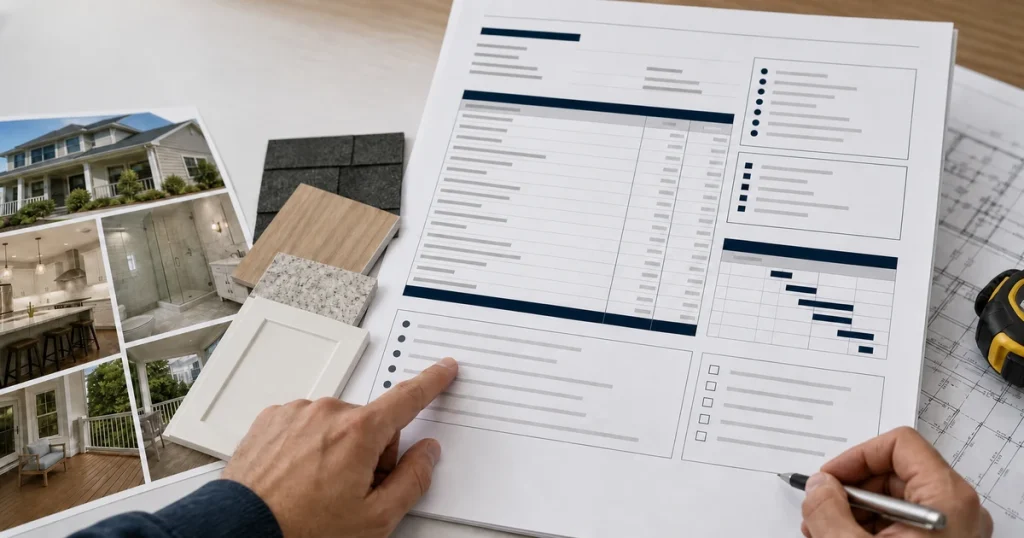
What Should a Professional Estimate Include?
An estimate can look official and still tell you almost nothing. If it gives you a business name, a short description, and one total, you know the price, but you do not know which version of the job that price buys.
The easiest way to expose what is missing is to read the estimate from the ending backward. Imagine the provider says the work is complete tomorrow. What would you expect to see, receive, test, and clean up before you agree?
Now look for each of those things in the estimate. If the ending exists only in your imagination, you and the provider may be pricing different jobs.
Begin with the completed result
A professional estimate should identify the result in language both sides can recognize. That may include a repaired system operating under stated conditions, installed materials in specified areas, a delivered report, configured software, completed training, removed debris, or a surface ready for the next trade.
Words such as “consulting,” “repair,” “optimization,” or “installation” are categories of work rather than complete deliverables. Ask what will exist when the work ends and what evidence will show that it is complete.
The answer does not have to guarantee every outside outcome. A marketer cannot guarantee revenue, and a repair may not prevent an unrelated future failure. But the provider should be able to define the work under their control.
Trace the steps required to reach that ending
Once the result is clear, the estimate should describe the important preparation, labor, installation, testing, delivery, and cleanup needed to produce it. The level of detail should match the cost, complexity, and risk of the job.
For physical work, identify the areas, quantities, measurements, surfaces, access, protection, removal, disposal, and restoration involved. For professional or technical work, identify the files, systems, meetings, configurations, documentation, access, testing, and handoff.
If drawings, photographs, measurements, inspections, or client-provided information shaped the estimate, identify them. That gives both sides a record of what the provider knew when the price was prepared.
Make assumptions visible before they become changes
Most disagreements do not begin with someone planning to be dishonest. They begin when the customer pictures normal access, existing conditions, utilities, working hours, materials, or client responsibilities differently from the provider.
You should expect the estimate to state the assumptions that materially affect price or schedule, because an unstated assumption can make both people believe they accepted a different version of the same job.
Suppose a flooring estimate assumes the room will be empty and the existing surface can remain. If the customer expects furniture moving and removal of damaged flooring, the total is not yet describing the same project. Writing down the assumption gives you a chance to correct it while the correction is still inexpensive.
Read exclusions as part of the price
An exclusion tells you which work and cost remain outside the estimate. Common examples include permits, engineering, hidden damage, owner-supplied materials, moving, travel, delivery, restoration, disposal, third-party fees, and work by another trade.
Exclusions are not automatically a warning. They are useful when they prevent a false assumption and assign responsibility clearly. They become a problem when the excluded item is unavoidable and nobody has included it in the real project budget.
Make materials and allowances comparable
Important materials should be identified by the level of specificity needed to compare quality and performance: type, grade, model, quantity, size, finish, or another meaningful standard. “Install new flooring” does not tell you whether two providers priced the same product.
An allowance is a placeholder for something not yet selected. The estimate should state the allowance amount, what it covers, whether tax, delivery, waste, and installation are included, and what happens when the final selection costs more or less.
Understand how the price can move
The estimate should say whether pricing is fixed, time and materials, unit-based, cost-plus, or a range. It should identify applicable labor rates, units, deposits, taxes, payment milestones, financing terms, and the length of time the price remains valid.
Then look for the change process. What evidence shows that additional work is necessary, who can authorize it, how price and schedule are updated, and what happens if the customer declines?
“Subject to change” is not a change process. A useful process makes the new condition visible before additional work and cost continue whenever circumstances reasonably allow.
Connect the schedule to real dependencies
An anticipated start date is not enough when the schedule depends on permits, materials, weather, access, another contractor, client decisions, or an initial payment. The estimate should identify the major dependencies and which person controls them.
Price validity and schedule availability are also separate. An estimate may remain valid for 30 days without reserving a place on the calendar, so ask what action actually secures the start window.
Define acceptance, warranty, and the next step
Return to the ending. Who inspects the work, which tests or documents are required, what counts as completion, how defects are corrected, and when final payment becomes due?
Summarize applicable warranties, limitations, maintenance responsibilities, and the process for requesting service. For regulated work, include the required license, registration, permit, or inspection information relevant to the job.
The FTC guidance on hiring a contractor recommends getting written estimates that describe the work, materials, completion date, and price. Those fundamentals also improve estimates for many services outside construction.
A strong estimate cannot predict every condition hidden behind a wall, inside a machine, or within an unfamiliar system. It can make the known result, assumptions, responsibilities, price rules, and definition of done clear enough that a surprise does not become an argument about what either person meant.