What Is Usenet Today, and What Should You Check Before Paying for Access?
Usenet is not a single website or streaming service. It is a distributed system of newsgroups and servers that exchange articles through the Network News Transfer Protocol, and most people access it through a paid provider and a newsreader or web interface.
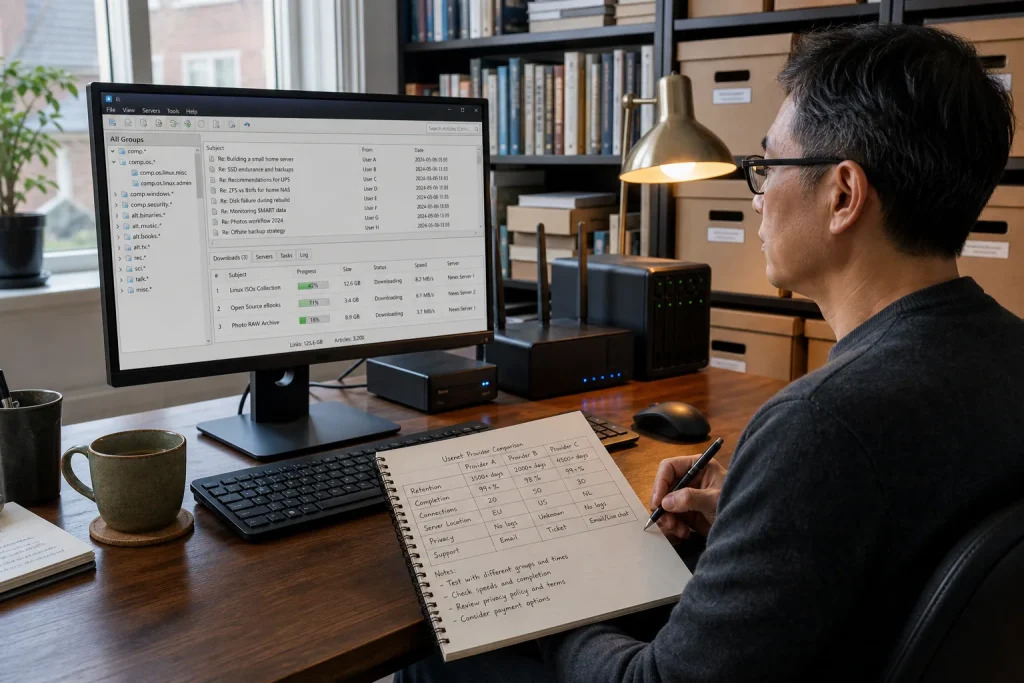
Before paying for a Usenet provider, you should decide whether you want text discussions, historical material, or access to binary groups, then compare coverage, retention, completion, software, privacy terms, support, and subscription conditions for that use.
Understand the pieces before comparing plans
The RFC Editor's NNTP specification describes the protocol used to select groups and retrieve or post articles. In everyday terms, a provider gives you access to news servers, while a newsreader is the application used to browse, search, download, and post.
Some providers include a newsreader or web search, while others supply server credentials and expect you to choose software, and although an indexing service may help locate articles, it is not the same thing as the provider that stores and delivers them.
Do not buy several services until you can explain which function each one performs. Many confusing setup guides assume you already understand this division.
Match retention and completion to what you need
Retention describes how long a provider says it keeps articles. Completion describes whether the articles or parts you request are actually available.
A large retention number matters less when you only follow current text discussions, but it matters more when you need older material. Even then, an advertised maximum may not describe every group or every article.
You should ask whether text and binary retention differ, which groups are carried, how missing articles are handled, and whether the provider offers a realistic trial or refund period. Test the groups and article ages you care about instead of relying only on an overall claim.
Review connection, software, and support
Confirm server locations, connection limits, encrypted connections, speed limits, operating-system support, and whether the included newsreader meets your needs. More simultaneous connections do not always produce more useful speed when your internet connection is already the limit.
For a beginner, clear setup instructions and responsive support may be worth more than a small difference in maximum performance. Check whether help covers only the provider's own application or also basic settings for third-party newsreaders.
Test one simple setup before adding more services
Start with one provider that offers a usable trial or refund period and either its included newsreader or one third-party newsreader you understand. The provider should give you a server address, port, username, password, encryption setting, and connection limit; enter those values exactly instead of copying settings from an unrelated setup guide.
Then follow this order:
- Connect with encryption enabled and confirm that the newsreader can retrieve the group list.
- Subscribe to or open one text group that matches your purpose.
- Retrieve a small recent article and, if older material matters, one item near the age you expect to use.
- Confirm that you understand where downloads are saved and how posting identity is configured before you post anything.
- Test the provider's support and cancellation instructions while the trial is still active.
Do not add an indexer, backup provider, block account, or several newsreaders merely because a setup article lists them. Add a second service only after the first test reveals a specific limitation, because otherwise you will not know which purchase solved a problem or which one created it.
Read privacy and posting expectations carefully
Encrypted transport protects the connection between your device and the server, but it does not make every action anonymous or lawful. Review logging, account, payment, data-retention, and disclosure terms instead of treating the word "SSL" as a complete privacy policy.
Material posted to distributed newsgroups may be copied to other servers and archives. Do not post personal or confidential information on the assumption that deleting it from one provider removes every copy.
You are responsible for complying with copyright, local law, group rules, and the provider's acceptable-use policy. A provider's technical ability to retrieve material does not give you the legal right to use it.
Check the subscription exit before the trial
The FTC's free-trial and auto-renewal guidance recommends confirming the price after a trial, renewal terms, and cancellation method. Record the deadline and test cancellation instructions before the offer converts.
Usenet can still be useful for long-running discussions, technical communities, and distributed archives, but the service market is not self-explanatory. Start with one purpose, one provider you can leave, and one newsreader you understand. Expand only after you know which limitation you are actually trying to solve.