What Should You Do When a New Cosmetic Causes a Skin Reaction?
You try a new cleanser, serum, hair product, or cosmetic, and a few minutes or hours later your skin starts burning, itching, swelling, or turning red. The first question usually sounds simple: “Is this normal, or am I having a reaction?”
If a cosmetic causes an unexpected skin reaction, you should stop using it, gently remove what remains, and keep the product and its label. What happens next depends less on whether the product is popular or described as “gentle” and more on your symptoms, how quickly they appeared, and whether they continue after the exposure stops.
Do not try to push through a reaction
Beauty advice sometimes treats stinging, peeling, or redness as proof that a product is working. That can be dangerously oversimplified because an active ingredient may cause an expected mild effect when used correctly, but burning, hives, swelling, blistering, or a spreading rash is not a result you should normalize.
The U.S. Food and Drug Administration advises consumers to stop using a cosmetic that causes an unexpected reaction and contact a healthcare provider. If the product is still on your skin, rinse or wash it away gently unless the label or a medical professional gives different instructions, and do not immediately cover the area with several other products in an attempt to cancel it out.
Treat the timeline like evidence
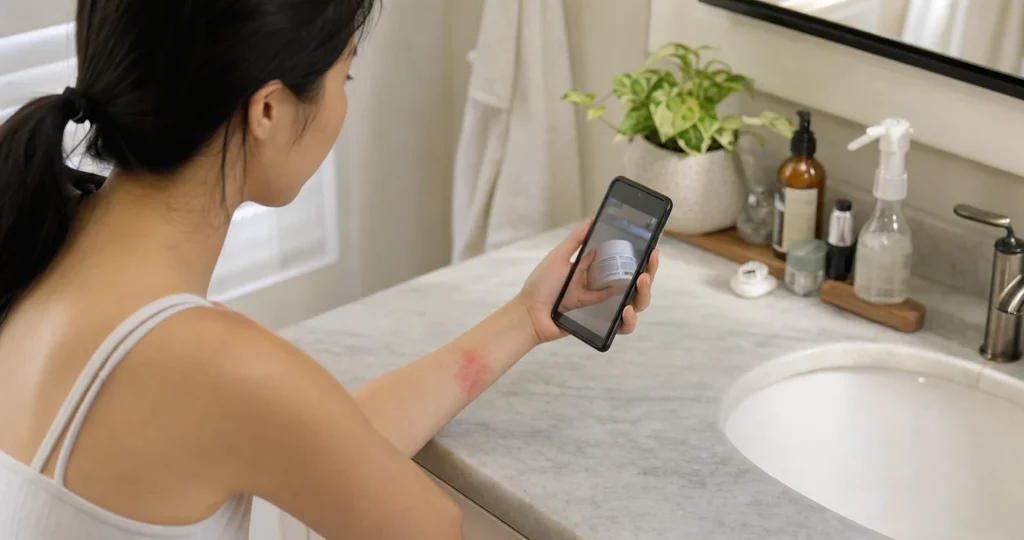
Before throwing the product away, take a clear photo of the front label, ingredient list, lot number, and affected area. Write down when you applied it, where you applied it, when the symptoms began, and what else was already on your skin.
That short record matters because a reaction may involve the product itself, an ingredient you have encountered elsewhere, two products used together, or a contaminated or degraded product. “My face reacted to something” is hard to investigate later, but a product name, ingredient list, timing, and photographs give a clinician something concrete to work with.
Know when the reaction needs urgent help
Call 911 or seek emergency care if you develop trouble breathing, throat tightness, faintness, or significant swelling of the face, lips, tongue, or throat. Those symptoms can signal a serious allergic reaction, and this is not a situation to monitor through social media comments or another application of the product.
You should contact a healthcare professional promptly for a severe or worsening rash, blistering, burns, eye involvement, infection signs, significant hair loss, or symptoms that do not improve after you stop the product. The FDA notes that cosmetic reactions can include rashes, redness, burns, infection, illness, and other unexpected effects, and it provides a process for reporting cosmetic product complaints.
Do not restart the whole routine at once
Once the reaction has settled and a professional has not told you otherwise, avoid reintroducing several new products together. If you restart everything on the same morning, you lose the ability to identify which product or combination caused the problem.
For recurring reactions, you should consider asking a dermatologist or allergist whether formal patch testing is appropriate. The FDA explains that cosmetic allergies often appear as itchy red rashes or contact dermatitis, while clinician-directed testing may help identify a specific allergen rather than leaving you to eliminate ingredients by guesswork.
The product label is part of your health record
A cosmetic reaction can make you want to throw the container away and never look at it again. But for the next few days, that container may be the most useful piece of evidence you have.
Stop the exposure, preserve the details, watch the symptoms, and escalate based on what your body is doing – not on what the marketing promised the product would do. That approach will not diagnose the reaction by itself, but it gives you a safer next step and a much clearer conversation with the professional who can.