How to Read an Auto Repair Estimate Before You Approve the Work
An auto-repair estimate can look precise while leaving the most important question unanswered: what diagnosis supports the repair? Replacing the named part may not solve the symptom when the shop hasn’t tested the system, and an inexpensive quote may omit labor, related parts, fluids, programming, or taxes.
You should ask the shop to separate diagnosis, recommended work, authorization, and final results. That makes it easier to approve necessary work without signing a blank check.
Choose the shop before the vehicle becomes an emergency
Look for experience with your make, model, powertrain, and problem. Ask about current technician credentials, required licenses, diagnostic equipment, parts policies, labor rates, warranties, storage fees, and how the shop handles work that exceeds the estimate.
Certification is useful evidence of training, but it isn’t a guarantee of honesty or a correct diagnosis. You should also consider communication, documentation, reviews that describe comparable work, and whether the shop can explain how it reached a conclusion.
Approve diagnosis before approving a guess
Describe the symptom, when it occurs, the recent work, the warning messages, the noises, the smells, and the changes in operation. Don’t demand a particular part because an online discussion matched one symptom.
Ask what diagnostic time costs, which tests will be performed, and whether that charge applies if you authorize the repair. A diagnostic fee pays for skilled testing; it should not be presented as proof that every recommendation is correct.
Read the estimate by scope, not only total
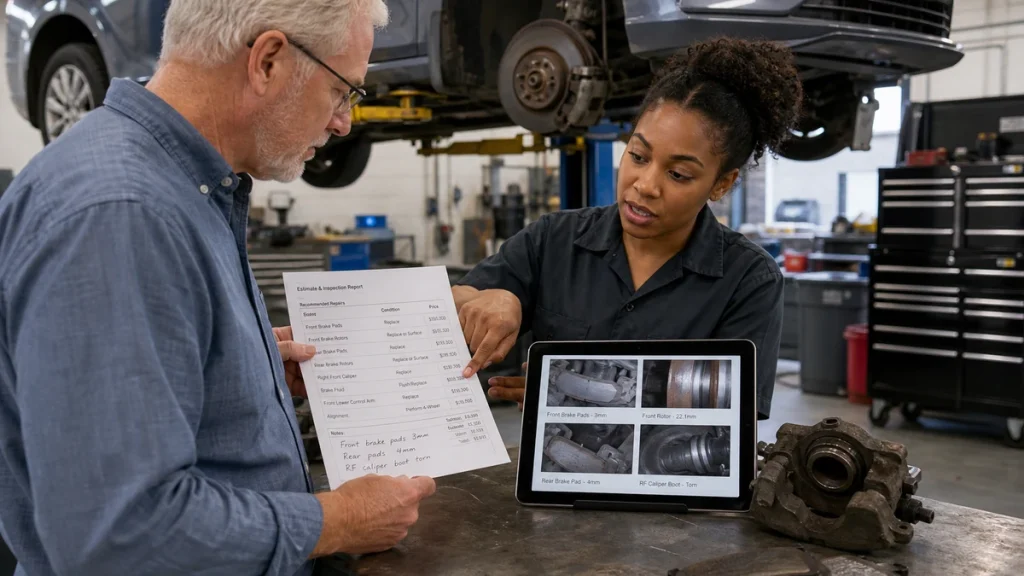
The Federal Trade Commission auto-repair guidance recommends a written estimate that identifies the condition, parts, and anticipated labor and states that the shop will seek approval before exceeding a specified amount.
Your estimate should show:
- the complaint and diagnosed condition
- parts with brand, type, quantity, and warranty
- labor operations, hours or flat-rate basis, and rate
- diagnostic, programming, shop-supply, disposal, and sublet charges
- fluids, fasteners, gaskets, and related work
- taxes and complete estimated total
- work that is urgent, recommended later, or merely observed
- the approval limit and contact method for changes
You should ask whether parts are new OEM, new aftermarket, remanufactured, rebuilt, or used. The correct choice depends on the component, vehicle, warranty, budget, and risk; "new" doesn’t always mean vehicle-manufacturer branded.
Ask how the shop will verify the repair
The final invoice should document the work performed, the installed parts, the test results, the warranty, and any remaining concerns. Ask whether the original symptom was reproduced before repair and how the shop confirmed it was corrected afterward.
Don’t accept a cleared warning light as the only proof when the repair involved drivability, braking, charging, cooling, or another condition that can return under load. Verification should match the original complaint.
When a second opinion makes sense
Consider another qualified opinion when the repair is expensive, the diagnosis is uncertain, several major assemblies are recommended, the explanation keeps changing, or the shop won’t document test results. You may still owe the first shop for legitimate diagnostic work.
A trustworthy repair process doesn’t promise that no additional problem can appear after disassembly. It gives you defined authorization points, evidence supporting the recommendation, and a written record of what the shop did with your vehicle and money.