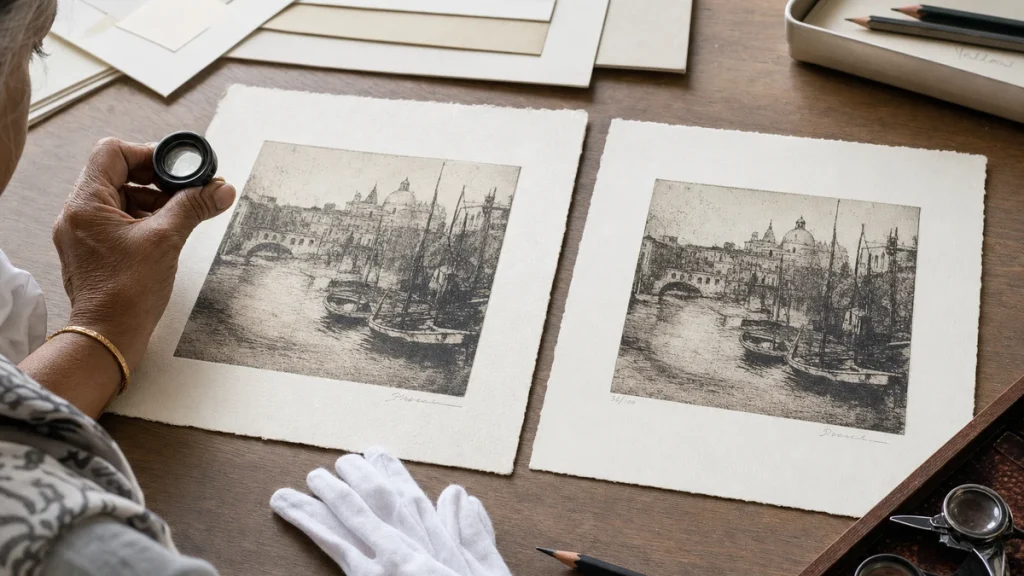
Is It an Original Print or a Reproduction? What Buyers Should Check
The word "print" describes more than one kind of object. It can mean an original work made through printmaking, a limited edition, or a photographic reproduction of an existing painting or drawing.
None of those categories is automatically bad. But you should know which one you are buying because the artist's involvement, scarcity, price, and collectible significance can be very different.
An original print is made as a print
In an original print, the artist creates or directs the image through a printmaking process such as etching, engraving, woodcut, screenprint, or lithography. Multiple impressions can be original works because the edition is part of the artistic process.
A reproduction begins with another original artwork and copies its image through a photographic or commercial printing process. A high-quality reproduction can be beautiful and worth owning, but it should not be represented as an original print.
The Smithsonian American Art Museum print research guide explains this distinction and notes that items marketed as fine-art or limited-edition prints may still be reproductions.
Read the edition notation carefully
A marking such as 5/25 usually means the impression is number five in an edition of 25. The Museum of Modern Art definition of an edition also notes that artist's proofs and other proofs may exist outside the numbered edition.
Edition numbers alone do not prove authenticity, quality, or value. A reproduction can be signed and numbered, and a genuine original print may be unsigned or unnumbered depending on its period and circumstances.
Ask for the process, publisher, and history
Before buying, ask:
- What process created the image on the paper?
- Was the work conceived as a print or copied from another artwork?
- Who printed and published the edition?
- What is the stated edition size, including proofs?
- Is the signature hand-signed, printed, stamped, or absent?
- Is there a catalog reference, invoice, certificate, or ownership history?
- Has the work been examined, restored, or reframed?
Specific answers are more useful than prestige words. "Archival," "museum quality," and "giclee" can describe materials or production, but they do not by themselves establish that a work is an original print or a sound investment.
Examine the object, not just the sales description
Look at the image surface, paper, margins, plate or screen evidence, signature, numbering, publisher marks, labels, and frame backing. Condition issues such as fading, foxing, moisture, trimming, adhesive, and acidic matting can affect both appearance and value.
Do not remove a work from an old frame or attempt cleaning merely to investigate it. If the price or claimed importance is substantial, you should use an appropriate print specialist, curator, conservator, or qualified appraiser.
Buy the claim you can verify
A seller should be able to put the material facts on the invoice: artist, title, date, medium or process, dimensions, edition information, and whether the object is an original print or reproduction. Keep that document with photographs and all supporting records.
You can enjoy a reproduction without pretending it is something else. The problem is not that affordable copies exist; it is that vague language sometimes asks you to pay an original-print price for a reproduction claim that no one has actually supported.