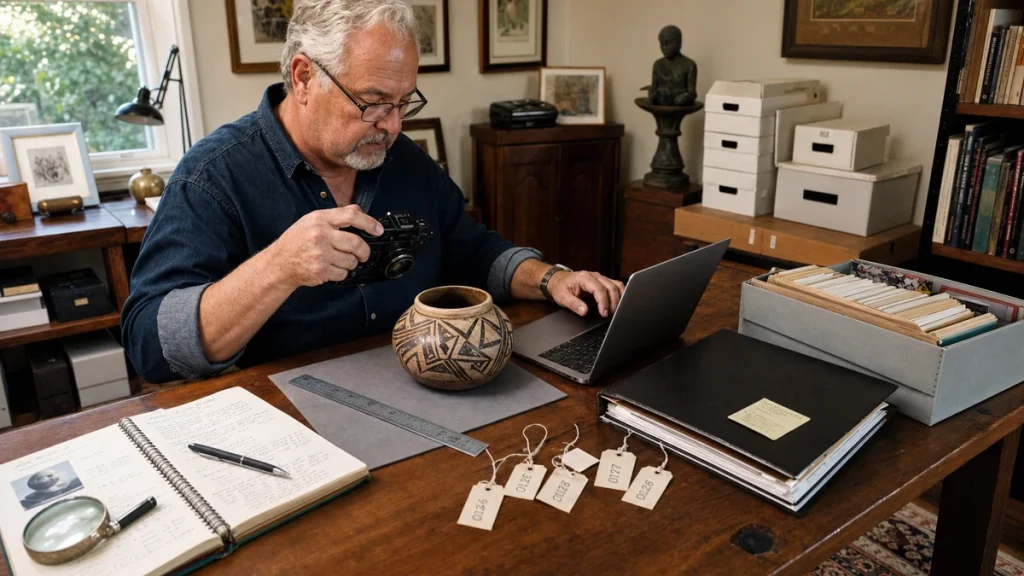
How to Catalog an Art or Collectibles Collection Before Records Are Lost
You don’t need a museum-sized collection before you need an inventory. If a piece is stolen, damaged, inherited, donated, insured, or sold, the record you create now may be more useful than your memory later.
You should catalog each object in a consistent way and keep a backup away from the collection itself. A list stored only in the same building can disappear in the same event that damages the objects.
Give every item a unique identifier
Create a simple numbering system that doesn’t depend on the object's current room or shelf. Locations change, and an identifier such as ART-2026-014 can stay with the item throughout its life in the collection.
Place the number on a tag, sleeve, box, or other safe location appropriate to the material. Do not write directly on an object unless a qualified collections professional has advised a reversible, material-safe method.
Record facts, documents, and uncertainty separately
For each item, record its creator or manufacturer, title or description, date, medium or materials, dimensions, identifying marks, acquisition date, source, purchase price, current location, and condition. Add clear photographs of the front, back, signature, labels, damage, and distinctive details.
Keep receipts, correspondence, certificates, prior appraisals, exhibition records, and ownership history with the catalog entry. If a detail is family tradition rather than documented fact, label it that way instead of turning a story into unsupported provenance.
The Smithsonian American Art Museum research guidance provides starting points for researching signatures, provenance, prints, and object value. Research can identify possibilities, but it isn’t the same as authentication or an appraisal.
Describe condition without trying to diagnose it
Record visible condition in neutral language: a two-inch tear at the lower edge, discoloration near the frame, a loose joint, or a missing label. Date the observation and add photographs so you can recognize changes over time.
Do not clean, tape, polish, reframe, or repair an unfamiliar object based on a generic internet tip. Materials react differently, and an attempt to improve appearance can remove evidence or cause permanent damage.
The Library of Congress preservation FAQ distinguishes preservation from conservation and explains when to seek a conservator.
Keep appraisal and insurance records current
An appraisal answers a value question for a stated purpose and date. Purchase price, sentimental value, resale estimate, estate value, and insurance replacement value aren’t interchangeable.
Ask your insurer what documentation it requires and whether valuable items need to be scheduled separately. Update records after a new appraisal, conservation treatment, move, loan, sale, or material change in condition.
Build a catalog you can actually maintain
A spreadsheet may be enough for a small collection. Specialized collection software can help when you need image management, document attachments, location history, loans, condition reports, and controlled access for several people.
Choose the simplest system that preserves these essentials:
- one permanent identifier per item
- searchable descriptions and locations
- dated condition photographs
- acquisition and ownership documentation
- appraisal, insurance, loan, and treatment history
- at least one secure off-site backup
Start with the objects that would be hardest to identify or replace. A complete basic record for ten important pieces is more useful than an elaborate system you abandon after cataloging one.