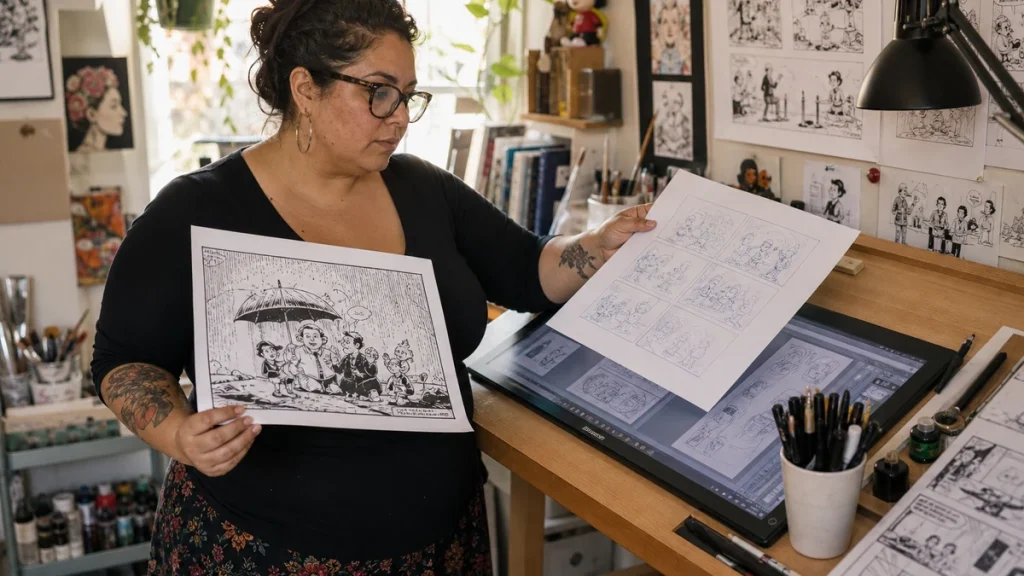
Should You License a Cartoon or Commission a Custom One for Your Business?
A cartoon can make a complicated point understandable in seconds, which is why businesses use cartoons in presentations, publications, training, advertising, and social media. The part that often causes trouble is not the drawing. It is the assumption that commissioning or downloading an image automatically permits every future use.
You should decide first whether you need to license an existing cartoon or commission a new one. Those are different transactions with different costs, timelines, and rights.
License an existing cartoon when the idea already fits
An existing cartoon may be the practical choice when the joke, message, and visual already match your purpose. Ask for a license that names the medium, audience, territory, duration, placement, and number of uses.
A license for one internal presentation may not cover a public advertising campaign, product packaging, merchandise, or indefinite reuse across every company channel. You should describe the real use rather than choosing the cheapest license and hoping it is broad enough.
Commission a custom cartoon when the message is specific
A custom cartoon makes sense when you need your own scenario, characters, product context, or brand voice. Give the cartoonist the situation, audience, point you want the reader to understand, and any wording that must appear.
Do not over-script the joke unless the exact language is essential. A cartoonist is not only illustrating your sentence; the artist is also solving timing, expression, composition, and visual clarity.
Ask what the quote includes
The quote should state the number of concepts, revision rounds, final dimensions, color or black-and-white treatment, file formats, deadline, and usage rights. It should also say whether editable working files are included and whether the artist may display the finished work in a portfolio.
You should ask whether fees change for paid advertising, a large print run, merchandise, exclusivity, or use of the image as a logo or mascot. These uses can carry more value and may require broader rights than an editorial or internal use.
Do not confuse a commission with automatic copyright ownership
Paying someone to create a cartoon does not automatically make every commission a "work made for hire." The U.S. Copyright Office work-made-for-hire guidance explains that the term has specific requirements.
If your business needs a copyright transfer, exclusive license, or limited license, put that agreement in writing. The document should identify the artwork and the exact rights being granted rather than using vague phrases such as "full use."
Protect both sides during review
Agree on when you will review the rough concept and when the drawing becomes final. Structural changes are usually easier at the sketch stage, while small wording or color corrections may be practical later.
Give consolidated feedback from one decision-maker whenever possible. Contradictory notes from several people can turn one revision into several new directions, and neither side has a reliable definition of done.
Questions to ask before you approve the project
- Is this an existing-image license or a new commission?
- What exact uses, channels, territory, and duration are included?
- Are paid advertising, merchandise, and resale included or excluded?
- How many concepts and revision rounds are included?
- What files and sizes will be delivered?
- Who owns copyright, and may either party reuse or display the work?
- What happens if the project is canceled or the deadline changes?
The safest agreement is not necessarily the one that gives you every imaginable right. It is the one that gives you the rights you actually need, at a price both parties understand, without leaving the artist or buyer to guess what "custom" means.