How to Evaluate a Used Vehicle Before You Buy It
A used vehicle can look clean, drive well for 15 minutes, and still carry a title, mechanical, or financing problem you won't see until after the sale. You don't need to diagnose every possible failure yourself, but you do need to know which checks belong to you and when to bring in an independent mechanic.
Work in order: verify the vehicle and records, inspect and drive it, then review the deal only after you know what you're actually buying.
Confirm that the vehicle and paperwork match
Copy the vehicle identification number from the dashboard and compare it with the title, registration records, listing, and door label. A mismatch, altered plate, or seller who will not provide the VIN is a reason to stop.
Ask who legally owns the vehicle and whether a lender still has a lien. Private-sale procedures vary by state, so check the motor vehicle agency where the vehicle will be titled.
For a dealer sale, read the Buyers Guide displayed on the vehicle. The Federal Trade Commission's used-car guidance explains that the guide tells buyers whether the vehicle is sold as-is or with a warranty and reminds them to get promises in writing.
Pull history from more than one place
A vehicle history report may reveal title brands, insurance losses, prior owners, odometer records, or reported accidents. It is useful screening evidence, but it cannot tell you how the vehicle runs today.
Use the VIN to check for open safety recalls through the National Highway Traffic Safety Administration. Confirm whether any listed repair has actually been completed.
Ask for maintenance invoices rather than accepting "regularly serviced" as a complete answer. Records that show dates, mileage, work performed, and the servicing shop are more useful than a stack of unexplained receipts.
Inspect the vehicle before the test drive
Look at the vehicle in daylight on a dry surface. Uneven panel gaps, inconsistent paint, fresh undercoating, overspray, water lines, musty odors, or corrosion in unusual places can justify a closer inspection.
Check the tires for matching sizes, adequate tread, age, and even wear. Uneven wear can result from alignment, suspension, tire-pressure, or structural problems.
Start the engine when it is cold if possible. Warning lights should illuminate during the startup check and then turn off as designed.
Do not let a disconnected battery or recently cleared warning light substitute for diagnosis. If readiness monitors are incomplete, the vehicle may need more driving before its emissions and fault systems can be meaningfully evaluated.
Use the test drive as a structured check
Drive at neighborhood and highway speeds when conditions allow. Include normal acceleration, braking, turning, reversing, parking, and a short period with the vehicle idling.
Pay attention to:
- delayed or harsh transmission behavior;
- pulling, vibration, or steering looseness;
- braking noise, pulsation, or instability;
- overheating or changing temperature readings;
- smoke, fluid smells, or warning messages; and
- electrical features that do not work consistently.
Test the heating, air conditioning, lights, windows, locks, cameras, screens, charging ports, seats, and driver-assistance features. Small failures can become expensive when they are part of an integrated electronic system.
Get an independent pre-purchase inspection
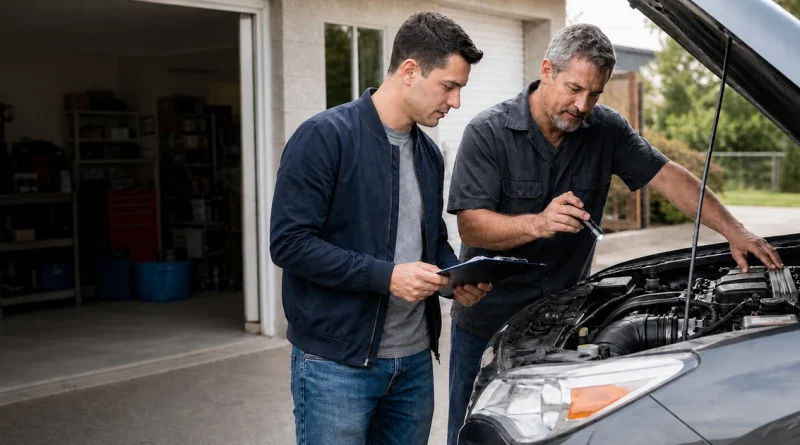
A history report does not replace an inspection. The FTC recommends having a used vehicle inspected by an independent mechanic, even when the dealer calls it certified.
You should choose the inspection shop yourself and ask for a written report, because while a seller-selected inspection may be competent, your own independent mechanic has no reason to minimize a problem to keep the sale moving.
The inspection should identify immediate safety concerns, current defects, upcoming maintenance, evidence of collision or flood damage, diagnostic codes, and estimated repair costs.
If a seller refuses any reasonable independent inspection, the safest response is usually to consider another vehicle. The inspection cost is small compared with accepting an unknown engine, transmission, structural, or electrical problem.
Calculate the cost after purchase
The purchase price is only the beginning. Add sales tax, title and registration, insurance, financing, immediate repairs, overdue maintenance, tires, and any accessories required for how you will use the vehicle.
Separate cosmetic preferences from work needed for safe and reliable operation. Use the inspection report to negotiate from evidence, not from a general feeling that the price is too high.
Compare financing by annual percentage rate, term, total of payments, and total sales price. A lower monthly payment can cost more overall when it extends the loan.
Review the final deal before signing
Make sure the VIN, price, trade-in value, down payment, financing terms, warranty status, service contract, add-ons, and promised repairs match what you agreed to. Remove products you did not knowingly choose.
Do not rely on a general assumption that you can return the vehicle in three days. The FTC notes that federal law does not create a universal three-day cancellation right for dealer vehicle purchases.
Leave with copies of every signed document, the final Buyers Guide, warranty or service-contract terms, inspection report, title paperwork, and proof of payment. A good purchase is not just a vehicle that drives well today; it is a vehicle whose history, condition, price, and legal transfer all make sense together.