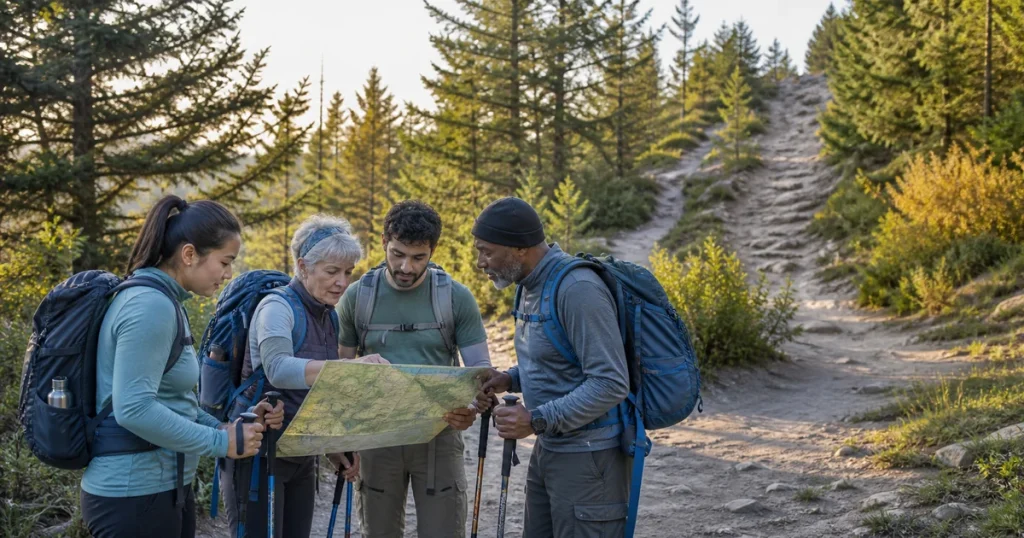
How Do You Choose a Hiking Trail for a Mixed-Ability Group?
For a mixed-ability hiking group, choose the trail around the least prepared person’s safe, enjoyable day – not the strongest hiker’s maximum. Compare distance, elevation change, surface, exposure, weather, altitude, navigation, facilities, and turnaround options before the group leaves home.
An easier route is not a failed adventure. The right trail lets the group stay together, finish with margin, and want to go again.
Ask what an ordinary day looks like for each person
“Beginner” and “active” are too broad. Ask what distance each person has walked recently, on what surface, with how much climbing, in what weather, while carrying what weight.
Also ask privately about injuries, mobility needs, medications, heat sensitivity, altitude experience, balance, and anything else that could change the plan. Nobody should have to disclose personal medical details to the whole group to request a shorter route, slower pace, or rest.
Read the trail beyond its difficulty label
A park’s “moderate” may feel very different from another park’s moderate. Check total distance, cumulative elevation gain, steep sections, rocks or roots, water crossings, exposed edges, shade, altitude, route-finding, and whether the group must return the same way.
Use the official park or land-manager page for current trail information, closures, permits, and alerts. Call or ask a ranger when the description does not answer a question that matters to your group.
Plan for the whole route, not the destination photo
Reaching the viewpoint is only half the trip. Budget energy, daylight, water, and attention for the return. A route that descends first can hide the hardest climbing until the group is tired.
The National Park Service’s Hike Smart guidance recommends choosing a trail everyone can successfully complete, letting the slowest hiker set the pace, staying together, tracking time and distance, and setting a turnaround time.
Build two good endings
Pick a primary route and a backup that still feels like a worthwhile outing. The backup might be a shorter loop, a lower-elevation trail, a paved path, or a walk with more shade and facilities.
Decide in advance what triggers the change: heat, storms, smoke, trail closure, late arrival, poor sleep, low energy, pain, or missing equipment. A plan made calmly at home is easier to follow than one negotiated at a crowded trailhead.
Set pace and turnaround rules before anyone is tired
Put a steady person at the front who will not pull the group faster, and assign an experienced person to stay at the back. Regroup at junctions and do not let one hiker quietly fall behind.
Choose a turnaround time that preserves daylight and reserve energy. Turning around is a planning decision, not a vote on whether the tired person is trying hard enough.
Carry what this route and group actually need
Match water, food, clothing, sun protection, lighting, navigation, first aid, and emergency communication to the trail, season, and conditions. Check that footwear and packs have been used before; the group hike is not the best place to discover that new gear causes pain.
Leave a trip plan with someone who is not going. Include the route, trailhead, people, vehicles, expected return, and what that person should do if the group does not check in.
Give the group permission to change the plan
Check in before the start, during breaks, and before committing to a section that is difficult to reverse. Ask specific questions such as “How do your feet and knees feel?” and “Could you comfortably do this much again?” rather than accepting a polite “I’m fine.”
If someone has a health condition or is unsure whether the exertion, heat, or altitude is appropriate, they should discuss the plan with a qualified healthcare professional. General trail advice cannot determine an individual’s medical fitness.
If the activity itself is still undecided, our guide to choosing a sport or recreational activity you’ll keep doing can help the group compare fit, access, cost, schedule, and recovery demands before buying equipment.
A good group hike is measured by the quality of the shared day, not the hardest trail anyone could have survived. Choose enough challenge to make the outing satisfying and enough margin to keep it safe.