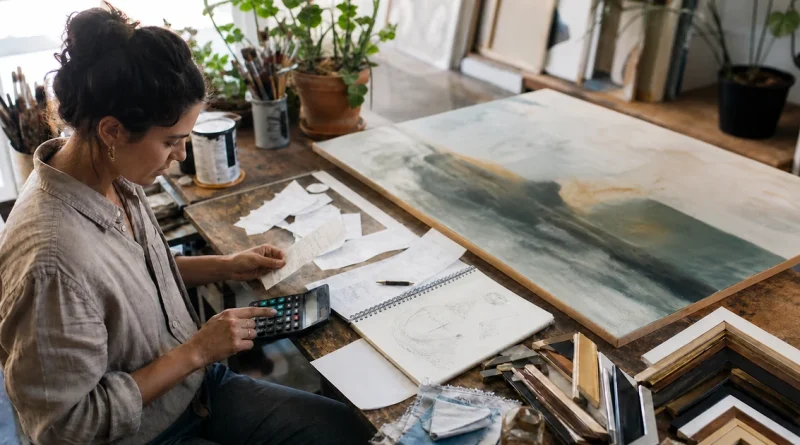
How to Price Original Artwork Without Guessing
Pricing your own work can feel uncomfortably personal. Charge too little and the work becomes difficult to keep making; choose a number you can't explain and every venue, commission, or slow sale can make you second-guess it.
You don't need one perfect formula. You need a repeatable base price that covers the work, fits where you are in the market, and stays consistent when the selling channel changes.
Start with the cost of making the work
List the direct costs tied to the piece. These may include canvas, paper, wood, clay, paint, printing, framing, fabrication, studio rental, hired assistance, packaging, and delivery.
Then estimate the time spent planning, making, finishing, documenting, and preparing the work for sale. Use an hourly rate that reflects the artist's experience and business costs, not only the local minimum wage.
A basic internal calculation can look like this:
- materials and outside production;
- labor hours multiplied by an hourly rate;
- a share of recurring overhead;
- a profit allowance; and
- selling-channel costs.
This calculation is a floor, not necessarily the final price. It shows when a price would make the work financially impossible to keep producing.
Choose a pricing unit that fits the work
Different bodies of work need different methods. A painter producing similarly finished canvases may use a price per square inch, while a sculptor may rely more heavily on labor, fabrication, and materials.
An illustrator doing commissioned work may price the project separately from the license to reproduce it. An artist selling prints needs to distinguish the price of an original from the price of a limited or open edition.
Whatever unit you choose, test it against several recent pieces. If a small, highly detailed work takes longer than a large, simple one, a size-only formula may need a complexity adjustment.
Separate the base price from the cost of selling
Suppose an artist needs to receive $600 for a piece before selling expenses. A gallery that retains 40 percent of the sale price does not leave the artist with $600 when the work is priced at $840.
The correct calculation is:
`buyer price = artist base price / (1 – commission rate)`
At a 40 percent commission, the buyer price would be $1,000. The gallery retains $400 and the artist receives the $600 base amount.
This distinction prevents a common mistake: adding 40 percent to the base price when the commission is actually 40 percent of the final price.
Keep public prices consistent
Buyers lose confidence when the same work is cheaper through the artist than through a gallery. Galleries may also be unwilling to represent an artist who undercuts them through direct sales.
Consistency does not mean every transaction has identical costs. Shipping, tax, installation, framing, and custom licensing can still be itemized when they genuinely differ.
The artwork's public price should remain understandable across channels. If a direct sale avoids a gallery commission, the artist can retain more of the price rather than training buyers to wait for a private discount.
Use comparable work carefully
Compare work by artists with a similar career stage, medium, scale, finish, audience, and selling environment. A famous auction result is not a useful comparison for an emerging artist selling directly at local events.
Look for repeated asking prices and actual sales when that information is available. One unusually high price does not establish a market.
Your own sales history matters most. Track which works sold, where they sold, how long they were available, whether buyers negotiated, and which sizes or formats repeatedly attracted interest.
Raise prices for a reason
A price increase is easier to defend when demand, costs, experience, exhibition history, or the quality and consistency of the work have changed. Raise prices in measured steps across a body of work instead of making random adjustments to individual pieces.
You shouldn't reduce the price of older work every time it does not sell quickly, because a slow sale can reflect the wrong audience, weak presentation, poor timing, or a piece that needs a different venue. And repeated discounting teaches buyers that waiting changes what the work is worth.
If lower-cost access matters, create a separate format such as studies, small works, or prints. That protects the price history of the primary body of work.
Account for rights separately
Selling a physical artwork does not automatically sell its copyright. The U.S. Copyright Office's visual-art guidance explains that visual artists generally own copyright when the work is created, subject to limited exceptions and written agreements.
If a buyer wants to reproduce the image on products, packaging, advertising, or other media, define and price that permission separately. The scope, duration, territory, and exclusivity of the license can materially change its value.
Build a price record you can explain
For every work, keep the title, date, medium, dimensions, direct costs, estimated hours, base price, public price, channel, commission, discounts, licensing terms, and final amount received.
The goal is not to defend every artistic choice with a spreadsheet. It is to make sure the business behind the art is consistent enough that the artist can keep creating and the buyer can understand what the price represents.