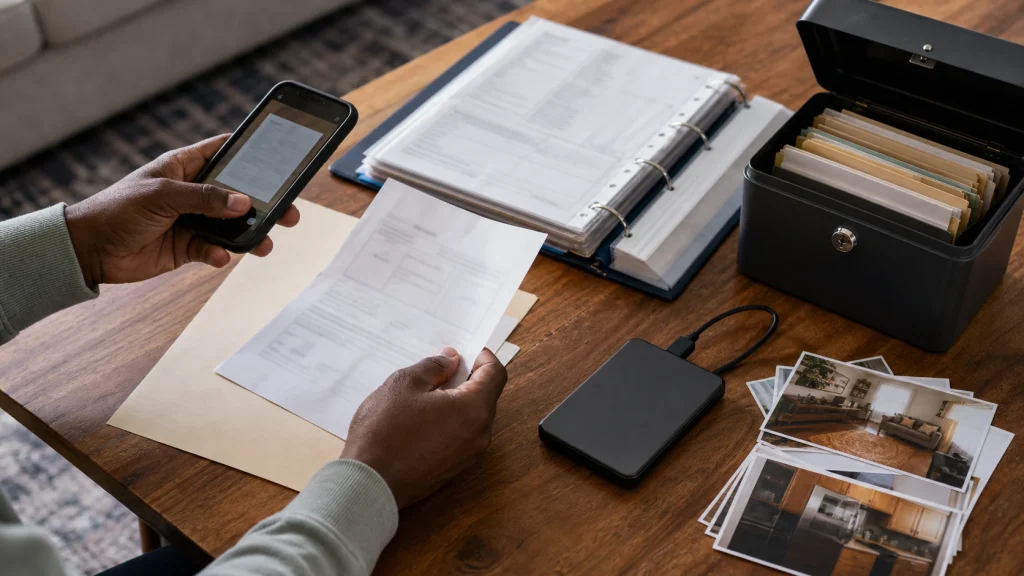
Which Household Records Should You Keep, Copy, and Protect?
You rarely discover that a household record is missing on a quiet afternoon when you have plenty of time to find it. You discover it after a storm, during an insurance claim, at the doctor’s office, or while trying to prove that an expensive appliance is still under warranty.
A useful household record system isn’t an archive of every piece of paper you have received. It is a recovery kit: the information you would need to prove, replace, repair, or continue the important parts of your life.
Organize records by what they help you do
Filing everything by company name can feel tidy until you need to answer a real question. Instead, group records around the action they support:
- Prove identity: birth certificates, passports, Social Security records, immigration documents, and marriage or name-change records.
- Prove ownership: deeds, vehicle titles, major purchase receipts, serial numbers, and photographs of valuable property.
- Recover financially: insurance policies, account contacts, tax records, loan information, and benefit documents.
- Continue care: medication lists, allergies, health insurance information, advance directives, and essential medical contacts.
- Maintain the home: permits, surveys, warranties, contractor records, manuals, paint details, and repair history.
This structure helps you notice what is absent. A folder labeled “Home” may look complete, while the question “Could I prove what was in the house after a fire?” exposes the missing inventory immediately.
Keep copies, but know which originals matter
A scan can help you retrieve information, but it may not replace an original certified document. Identify records that institutions may require in original or certified form, then protect those accordingly.
For the working set, scan both sides when the back contains endorsements, terms, or identification details. Use file names a person other than you could understand, such as “2026-home-insurance-policy.pdf,” rather than a camera-generated number.
Do not keep the backup beside the original
A fireproof box and the folder on the desk can both be lost in the same event. The Ready.gov financial preparedness guidance recommends gathering financial, household, and medical information before an emergency and keeping important records protected.
You should keep at least one protected copy away from the originals. That might be encrypted cloud storage, an encrypted drive stored elsewhere, a safe-deposit box, or a trusted person’s secure location. The right option depends on how quickly you need access and how sensitive the record is.
Protect access as carefully as the files
A folder containing identity documents, account numbers, and insurance details can help you recover, but it can also help a thief impersonate you. Do not place an unencrypted copy on a shared drive or send the whole archive through ordinary email for convenience.
Make sure one trusted person knows that the system exists and how to reach it if you can’t. This doesn’t require handing over every password today; it means making sure they know how to get the information they would need.
Review the records once a year
Household records age quietly. Policies renew, prescriptions change, warranties expire, and emergency contacts move.
Attach a review to an event that already happens, such as filing taxes, renewing home insurance, or changing smoke-alarm batteries. Replace expired copies, add major purchases, remove documents you no longer need, and confirm that the backup still opens.
The test is simple: if you had to leave home tonight with only your phone and wallet, could you still find the information needed to identify your household, contact the right institutions, document what you own, and begin recovering? Build the records around that moment.