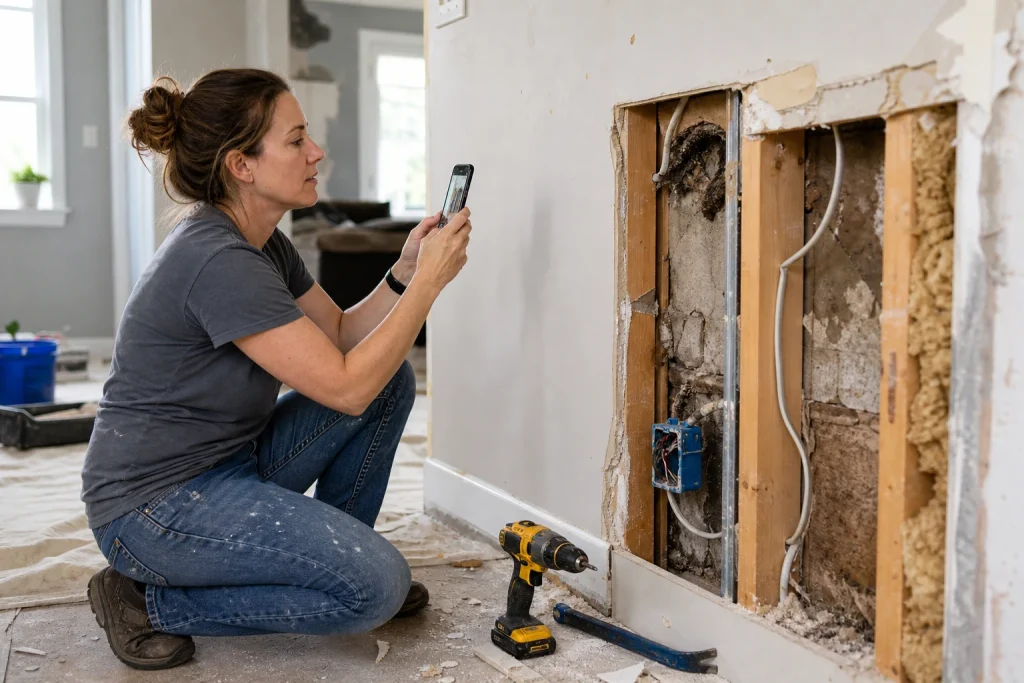
Which Home Projects Are Reasonable to DIY – and Which Warning Signs Mean Stop?
The internet can make almost any repair look manageable because the video begins after the difficult diagnosis and ends before the hidden consequence. You see the clean cut, the tightened fitting, or the new switch – not the uncertainty the person resolved before touching it.
Before deciding whether to DIY a home project, judge the consequence of being wrong. A crooked shelf and a concealed electrical fault are both mistakes, but they don’t carry the same level of risk.
Start with four questions the tutorial cannot answer for you
- Can I identify the actual problem, or am I only treating the visible symptom?
- Can a mistake cause fire, shock, gas exposure, flooding, structural failure, toxic-material exposure, or injury?
- Can I make the work safe and verify that it is safe when finished?
- Do permits, licensing, insurance, a warranty, or a future sale require qualified work or documentation?
If you can’t answer those questions confidently from reliable instructions and your actual house, the next step is diagnosis or professional advice – not a bigger tool purchase.
Use reversibility as a practical dividing line
Low-consequence work is usually visible and reversible: painting a room, replacing simple hardware, assembling shelving, or repairing a cosmetic surface. You can inspect the result, undo it, and learn without putting a major system behind a wall at risk.
Risk rises when the work becomes concealed, energized, pressurized, structural, elevated, or connected to combustion. Electrical panels, gas lines, load-bearing changes, roofing at height, major plumbing inside walls, asbestos or lead disturbance, and equipment venting deserve a much higher threshold than “I found a video.”
Stop when the house contradicts the instructions
A tutorial may show modern wiring, standard framing, a known pipe material, and generous access. Your house may contain previous repairs, corrosion, water damage, unusual circuits, mixed materials, or a configuration the instructor never encountered.
Do not improvise through an unexplained burn mark, hot wire, gas odor, damaged structural member, active leak, crumbling suspect material, or missing shutoff. Make the area safe if you can do so without exposure, keep people away, and call the appropriate qualified professional or emergency service.
Some safety systems should never become experiments
Carbon monoxide is colorless and odorless, so your senses can’t verify that combustion equipment or venting is safe. The Consumer Product Safety Commission recommends annual service of heating systems by a trained technician, working carbon monoxide alarms on every level and outside sleeping areas, and never using ovens, grills, or indoor generators for heat; its carbon monoxide safety guidance explains the danger in detail.
A successful-looking repair isn’t enough when the hazard is invisible. Verification may require an electrical tester, pressure test, combustion analysis, inspection, or permit closeout that belongs in the project plan from the beginning.
DIY can include doing the preparation well
Hiring a professional doesn’t mean surrendering the whole project. You can document symptoms, clear access, compare scopes, select finishes, handle safe demolition or painting if approved, and ask how the finished work will be tested.
The broader guide to deciding whether to DIY or hire a professional can help you compare time, tools, skill, and cost. Before starting, ask this question first: if I am wrong, what can happen before I discover it?
Live Minder Connect member business
D&R Landscape and Excavation
Services · Fort Pierce and service areas across Florida
D&R Landscape and Excavation provides land clearing, forestry mulching, excavation, grading, landscaping, irrigation, lawn maintenance, tree services, and storm cleanup across Florida.