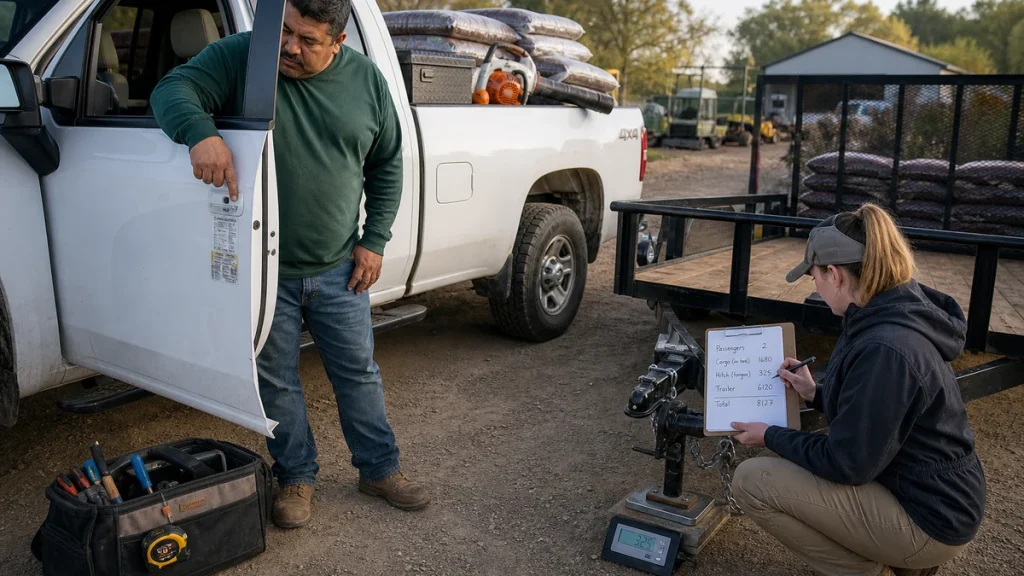
Payload vs Towing Capacity: How to Choose a Truck for the Real Load
A truck's advertised maximum towing number doesn’t tell you whether a particular truck can safely carry your passengers, cargo, hitch, and trailer tongue weight at the same time. Configuration, options, axle ratings, payload, hitch limits, and the fully loaded trailer all matter.
You should start with real loaded weights and the labels for the exact truck, not the best number available somewhere in the model lineup.
Separate payload from towing capacity
Payload is the weight the truck carries, including people, cargo, accessories, and trailer tongue or king-pin weight. Towing capacity describes the trailer weight a properly configured vehicle may tow under stated conditions.
A heavy trailer can remain within a published towing limit while pushing the truck over its payload, rear axle, tire, or hitch rating. The Ford towing guidance explains that passengers, cargo, accessories, and tongue weight affect the available ratings.
Read the exact truck's labels and guide
Find the gross vehicle weight rating, gross axle weight ratings, tire load limits, and payload information on the vehicle labels. Use the VIN-specific configuration, the owner's manual, the towing guide, the hitch label, and the trailer documentation.
Do not rely on a salesperson's memory or a generic internet search for the same model name. A cab, bed, drivetrain, engine, axle ratio, suspension, wheel, or option change can produce a different rating.
Build the loaded scenario
List the driver, the passengers, the tools, the fuel where applicable, the bed cargo, the topper, the rack, the auxiliary tank, the hitch equipment, and any permanent accessories. Then include the trailer's loaded weight and expected tongue or king-pin weight.
You should weigh the combination at a suitable scale after it is configured. Estimate sheets help during shopping, but actual axle and combination weights show what the truck is carrying in use.
Match the truck to more than weight
Consider trailer frontal area, braking requirements, wheelbase, hitch type, cooling, transmission, mirrors, tires, terrain, grades, altitude, weather, and frequency of towing. A combination that stays within ratings can still be unpleasant or poorly suited to daily work.
If you are buying for a business, calculate time off road, maintenance access, upfit weight, licensing, insurance, and the cost of moving to a larger truck later. Buying exactly at the edge of every rating leaves little room when real work changes.
Numbers to verify before buying
- payload label for the exact truck
- GVWR and front and rear GAWR
- tire and wheel load ratings
- gross combined weight rating
- maximum loaded trailer weight for the configuration
- receiver, ball, hitch, and king-pin limits
- estimated and measured tongue or pin weight
- passengers, cargo, accessories, and upfit weight
- trailer brake and controller requirements
A truck is properly matched when all relevant ratings remain satisfied in the loaded condition, not when one maximum number exceeds the empty trailer's advertised weight. If the calculation depends on leaving passengers, tools, or supplies behind, the truck may not fit the job you are actually buying it to do.