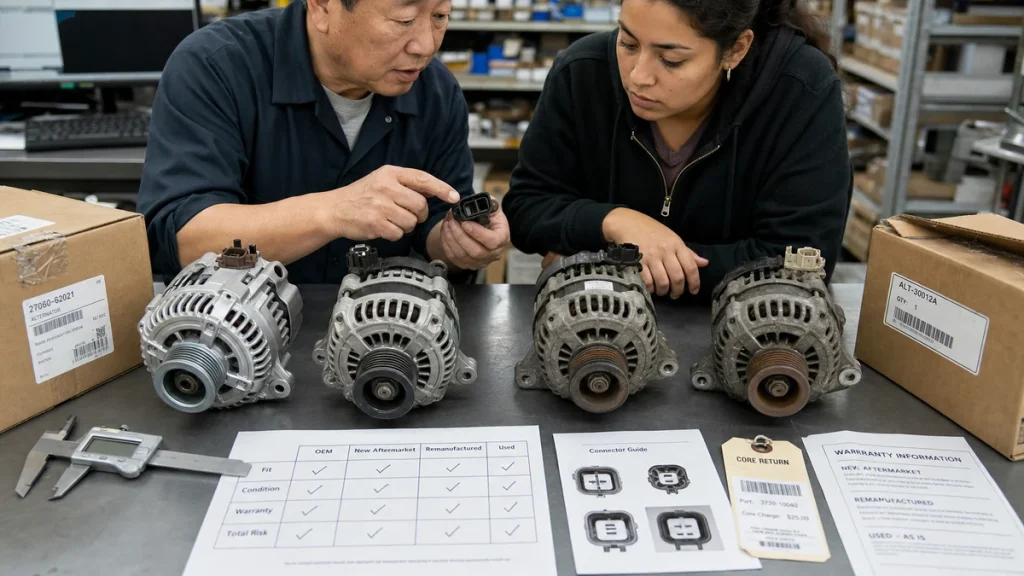
OEM, Aftermarket, Remanufactured, or Used: Which Car Part Should You Buy?
Replacement parts are often described as OEM, aftermarket, remanufactured, rebuilt, recycled, or used. Those labels don’t create a simple quality ranking, and the cheapest part price doesn’t show the total cost when labor, programming, fit, downtime, and warranty are included.
You should choose the part based on the exact application, component risk, supplier traceability, installer requirements, and who will pay if the part fails.
Understand the common part categories
OEM usually refers to a part sold under or through the vehicle manufacturer's system. Aftermarket parts are produced and sold outside that channel, sometimes by the same kinds of suppliers and sometimes to different specifications.
Remanufactured parts are generally disassembled, cleaned, inspected, and restored through a defined production process. Rebuilt can describe a repair with a narrower replacement scope, while used or recycled parts come from another vehicle and retain an unknown amount of service life unless documented.
Ask the seller to define its term. "OEM quality" isn’t the same statement as OEM, and "new" doesn’t tell you the manufacturer, certification, or country of origin.
Match more than the vehicle year and model
Use the VIN, the production date, the engine, the transmission, the drivetrain, the trim, the emissions package, the brake package, the axle, the calibration, and the original part number when relevant. Manufacturers can change components during a model year.
You should compare connectors, mounting points, dimensions, software, sensor requirements, and superseded part numbers. A listing that says a part fits hundreds of vehicles deserves verification against a professional catalog or manufacturer data.
Consider the consequence of failure
For brakes, steering, restraints, lighting, tires, fuel, high-voltage systems, and other safety-critical applications, prioritize traceability, correct specification, and qualified installation. The NHTSA explanation of replacement-equipment recalls confirms that safety-related defect and recall authority can apply to aftermarket equipment as well as original equipment.
That doesn’t mean every aftermarket part is inferior. It means the decision should be supported by a known manufacturer, correct application, appropriate standard, supplier support, and a warranty that has practical value.
Include installation and the cost of a failure
A less expensive part can cost more when replacement requires many labor hours, programming, alignment, calibration, fluids, or repeated downtime. Ask whether the shop warrants labor if a customer-supplied part fails and who pays diagnostic and removal time.
For used electronic modules, keys, controllers, and security components, confirm whether the part can be programmed to another vehicle. Some components are locked, paired, or restricted by software even when the hardware number appears correct.
Questions for the supplier or installer
- What manufacturer and exact part number am I receiving?
- Is it OEM, aftermarket, remanufactured, rebuilt, or used?
- How was fit verified against my VIN and configuration?
- What testing, certification, or condition grading applies?
- Are programming, calibration, core return, and related parts included?
- Who covers part, labor, shipping, and downtime if it fails?
- How is a warranty claim submitted and resolved?
- Is the part subject to an open recall or service bulletin?
The best replacement part isn’t always the most expensive or the one in the vehicle manufacturer's box. It is the part whose identity, fit, risk, installation, and warranty you can verify before the vehicle is disassembled.