What Files Should a Graphic Designer Give You at the End of a Project?
When a graphic-design project ends, the image you can see is only part of what you may need. A logo that looks fine in an email can fail when a sign company, printer, web developer, or future designer needs to use it in another format.
You should agree on final deliverables before the project starts. "Send me the logo" isn’t specific enough to guarantee that your business receives usable, editable, and properly licensed assets.
Ask for files matched to real uses
For a logo or identity project, you may need vector files such as SVG, EPS, or AI for scaling and professional production, plus PDF, PNG, and JPG versions for common office and web use. Ask for full-color, one-color, black, white, horizontal, stacked, and icon versions when those variations are part of the approved system.
For print work, confirm final dimensions, bleed, color mode, image resolution, and whether the printer needs a packaged source file or press-ready PDF. For digital work, confirm pixel dimensions, responsive variations, file size, and accessible text alternatives where relevant.
Don’t request every file the designer has ever created just because you’re unsure what you need. You should identify the files another qualified provider would reasonably need to reproduce, update, or deploy the approved work.
Distinguish final artwork from working files
Final artwork is the approved deliverable. Working files can include unused concepts, drafts, linked images, fonts, templates, code, plugins, and process materials that weren’t necessarily included in the price.
If editable source files matter to your continuity, name them in the proposal. Ask whether they are included, available for an additional fee, or dependent on software and third-party assets that your business must license separately.
Confirm the rights, fonts, and stock assets
Your agreement should state what rights transfer after final payment and what the designer retains. It should also identify stock photography, illustrations, fonts, templates, or other third-party materials and explain whether your license covers the intended channels, duration, audience, and editing.
The U.S. Copyright Office copyright overview explains that ownership of a copy is distinct from ownership of copyright. A folder of files doesn’t resolve usage rights unless the agreement does.
Do not assume a font embedded in a PDF can be handed to every future vendor. Font licenses often apply to particular users, devices, websites, applications, or production uses.
Request a handoff someone else can understand
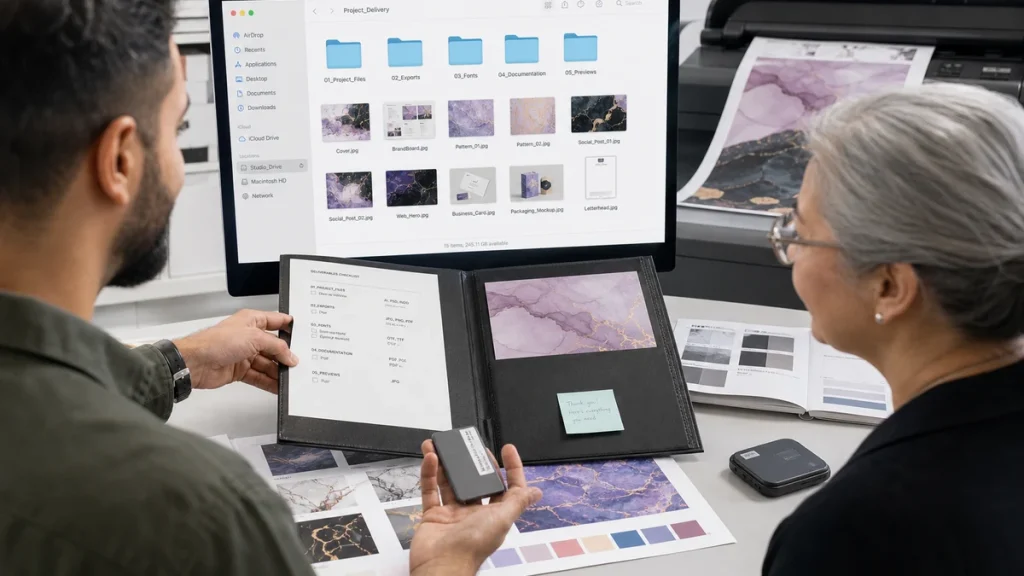
A practical handoff can include:
- a clearly named folder with approved versions only
- vector and common raster formats
- color values for print and screen
- font names and license notes
- minimum size, spacing, and background guidance
- links or copies for properly licensed third-party assets
- instructions for unusual production or export settings
- the source-file and archive policy
Open a sample of every delivered file and keep two backed-up copies. You should also send the package to the printer, developer, or production partner early if the design will immediately move into another workflow.
Watch for the one-file mistake
A single flattened JPG may be enough for one social post, but it isn’t a complete identity system. Enlarging it can blur the image, changing its colors can produce inconsistent branding, and rebuilding it later costs more than a proper handoff.
You don’t need every file the designer has made. You need the approved design in the formats you agreed on, with enough instructions and license information to use it where you planned. Check that before a deadline leaves you trying to recreate the work or obtain a missing license.